The Sourcing Problem Behind Every Aviation Emissions Engagement


When a client asks you to stand behind their aviation emissions, the hard part is rarely the calculation. It is sourcing defensible flight activity in the first place.
Scheduled travel reconciles cleanly from booking records. Charter rarely does. It arrives as spend, and spend is not a measurement.
So the analytical work you are good at stalls on a data problem you did not sign up to solve.
The rest of this article shows how that sourcing problem can be solved without operating a global flight-data operation.
The underlying dataset currently covers more than 2.5 million tracked private flights across 22,569 aircraft, allowing charter spend to be reconciled against observed flight activity rather than generic emission factors.
Why charter breaks a spend-based estimate
A spend factor describes an average trip.
Charter pricing reflects aircraft availability and positioning, not fuel consumed, so the actual footprint depends on the specific routes flown.
That is exactly what per-flight measurement recovers, and it is why the same client can look very different once the flights are reconstructed.
For a client that has to defend the number to its own auditor, that difference is the engagement.
Spend is an accounting record. Flight activity is the measurement.
The engagement, walked through
Anonymised and illustrative. Figures are internally consistent, to be replaced with each client's measured output.
The client had booked chartered travel as spend and converted it with a generic factor. We rebuilt it from observed flights.
The reconciliation runs the same way every time:
- The client supplies charter spend, or a list of tail numbers they charter.
- Invoice periods are aligned with observed flights.
- Observed flights are matched to the client's charter activity where possible; unmatched activity remains explicitly estimated.
- CO2 is calculated per flight with the published methodology.
- Coverage completeness accompanies every reported figure.
- The consultancy delivers the reconciliation under its own brand.
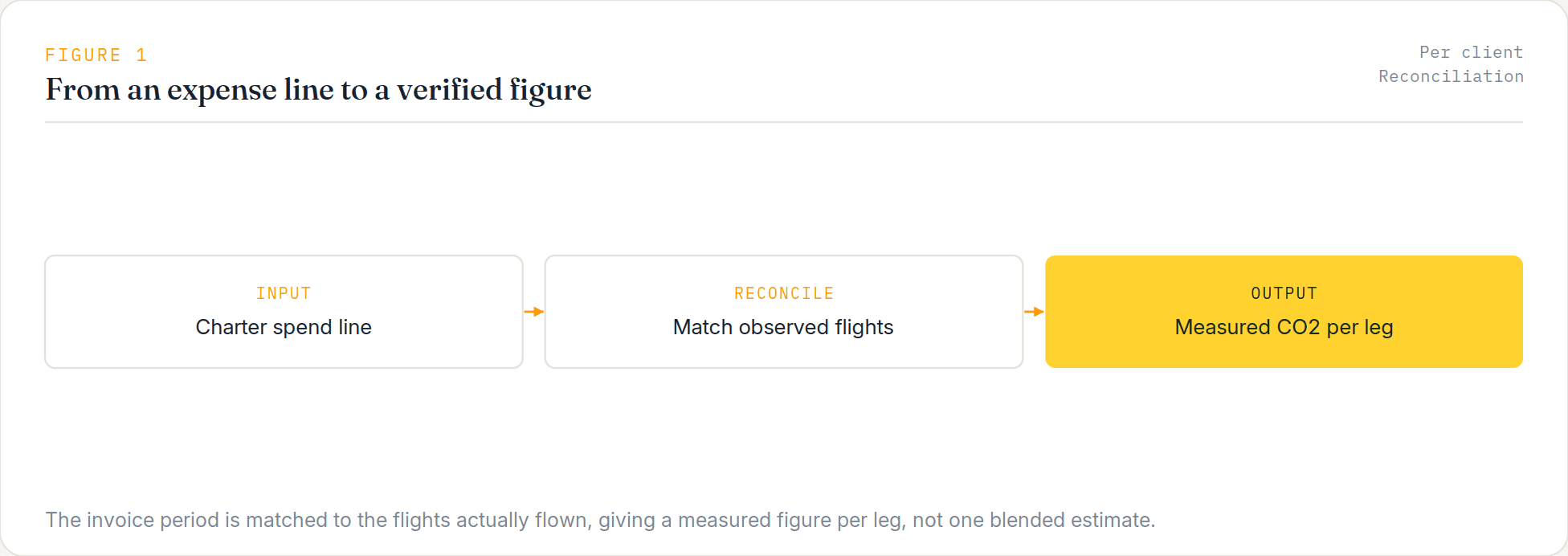
Figure 1: from a client expense line to a verified CO2 figure.
For this client, the measured total came out about 29% above the spend-based figure, driven by short repositioning legs.
The result was a per-flight reconciliation the client's own auditor could follow, with measured and estimated legs separated and coverage completeness stated, issued under the consultancy's own brand.
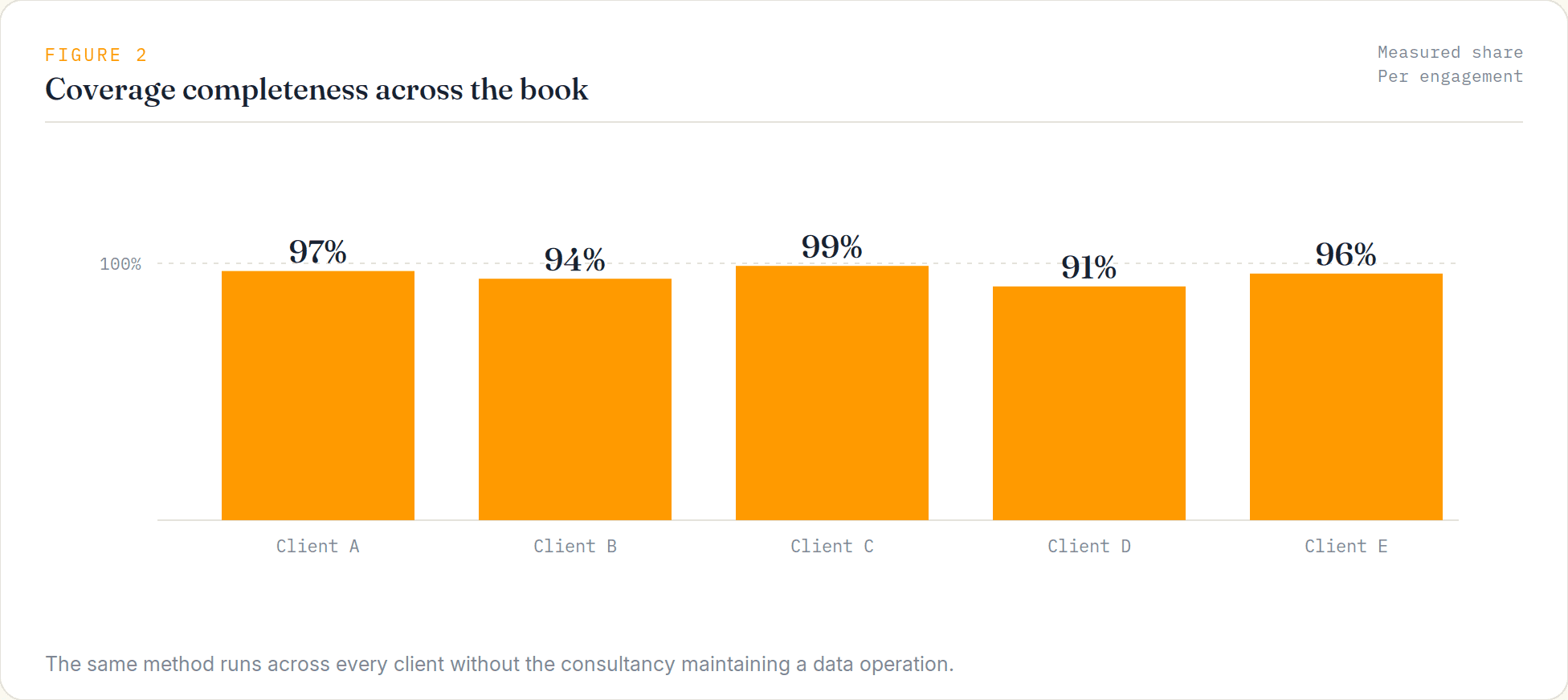
Figure 2: coverage completeness across a client book. Measured share per engagement.
Why consultancies do not build this themselves
Building the alternative in-house means continuous flight tracking across a global fleet, consistent aircraft matching over time, and a defensible emissions model, maintained indefinitely.
That is a data operation, not a deliverable, and most consultancies should no more run it than run their own market-data terminals.
The reconciliation can therefore be repeated across every client while the underlying data operation is maintained centrally rather than separately by each consultancy.
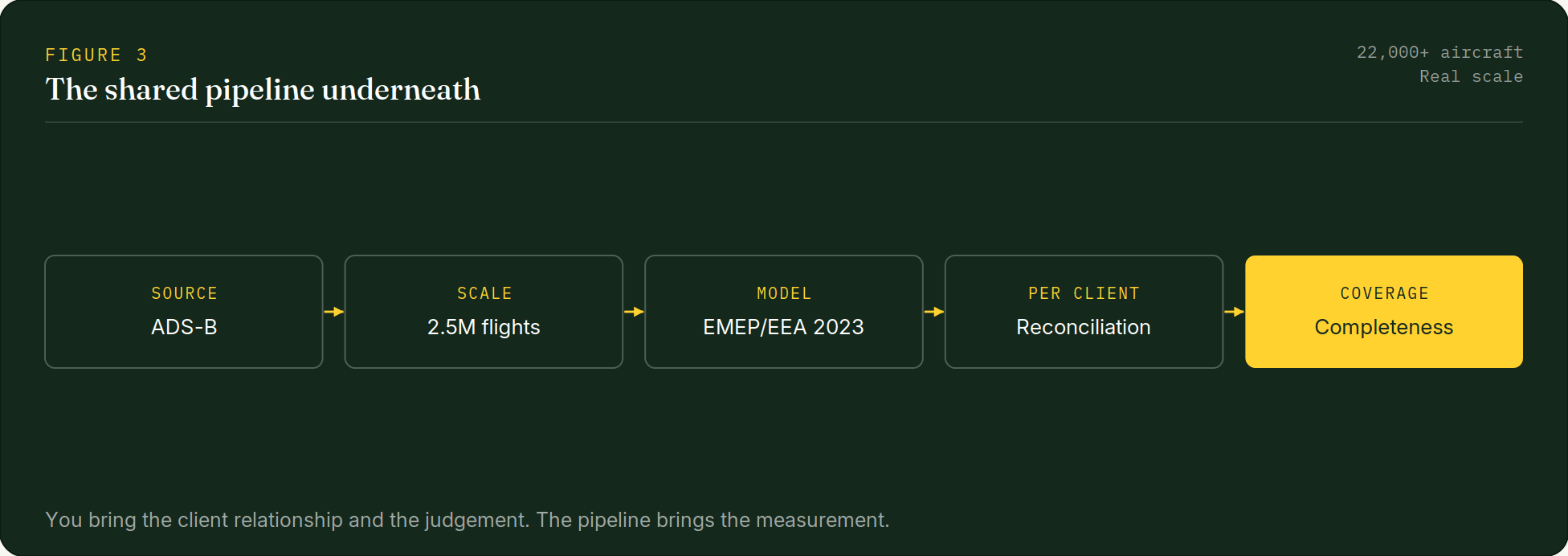
Figure 3: the shared pipeline. ADS-B, EMEP/EEA 2023, per-client reconciliation, coverage note.
The data and methodology
The methodology is public.
The difficult part is maintaining verified flight activity at global scale.
Flight activity comes from ADS-B.
Emissions are calculated using the published EUROCONTROL EMEP/EEA 2023 methodology, with fixed conversions and no smoothing or interpolation applied to measured flights.
Coverage completeness travels with every reported figure, so you can show a client's auditor how much of a number is measured rather than inferred.
What this cannot tell you
Being explicit about the limits is what makes the rest defensible.
It measures emissions at flight and route level.
It does not name individuals, and it does not invent data.
Unmatched legs are shown as estimates, not disguised as measurements. And it is an input to your engagement, not a replacement for your advisory judgement.
Those constraints are what let you put your name on the output.
Client reconciliation is only one application.
The same data also supports benchmark reporting, sector comparisons, and reduction-pathway analysis.