Scope 3 Aviation Emissions: How Companies Should Account for Private Jet Travel


Private jet travel is one of the most carbon-intensive activities a company can sponsor.
A single large cabin flight hour produces more CO₂e than the average UK household uses in a year for heating and electricity combined.
Yet it is also one of the most poorly disclosed line items in corporate sustainability reports, often buried inside Scope 3 Category 6 estimates, allocated by spend rather than fuel burn, or excluded entirely under the convenient label of “not material.”
That gap is closing.
Under the EU’s Corporate Sustainability Reporting Directive (CSRD), the IFRS Foundation’s ISSB standards, and California SB 253, Scope 3 disclosure is moving from voluntary to mandatory for an expanding pool of companies with auditor assurance attached.
Investors and regulators increasingly want to know not just total Scope 3 emissions, but the methodology, the activity data, and the source of the underlying numbers.
This article sets out a practical framework for sustainability managers and reporting teams: where private aviation actually sits in the GHG Protocol, which standards apply, how to calculate the impact of an aircraft fleet at investor-grade quality, and which metrics matter when the auditors arrive.
Key takeaways
- Most companies report private jet emissions as Scope 3 Category 6 (Business Travel) when chartered, and Scope 1 when the aircraft is owned and operated by the reporting entity
- The hardest gap is personal use of company aircraft by executives - emissions stay in Scope 1 under GHG Protocol, but the SEC perquisite rules and ESG analysts increasingly track this as a separate disclosure
- Spend-based emission factors materially understate private aviation emissions. Distance or fuel based methods using actual flight activity data are required for credible disclosure under ESRS E1
- Carbon Sky Index data covering 2.0 million private flights since January 2025 shows fleet-average emissions of 1.81 tCO₂e per flight hour, rising to 2.78 tCO₂e per hour for large cabin aircraft
- The top decile of tracked aircraft emit roughly 4.5× the fleet average per year. Concentration that materially affects the disclosed footprints of the companies that operate them
Where does private aviation sit in the GHG Protocol?
The Greenhouse Gas Protocol Corporate Value Chain (Scope 3) Standard divides emissions into three scopes and fifteen Scope 3 categories.
Where a private jet flight lands in that taxonomy depends entirely on a single question: who owns or operates the aircraft?
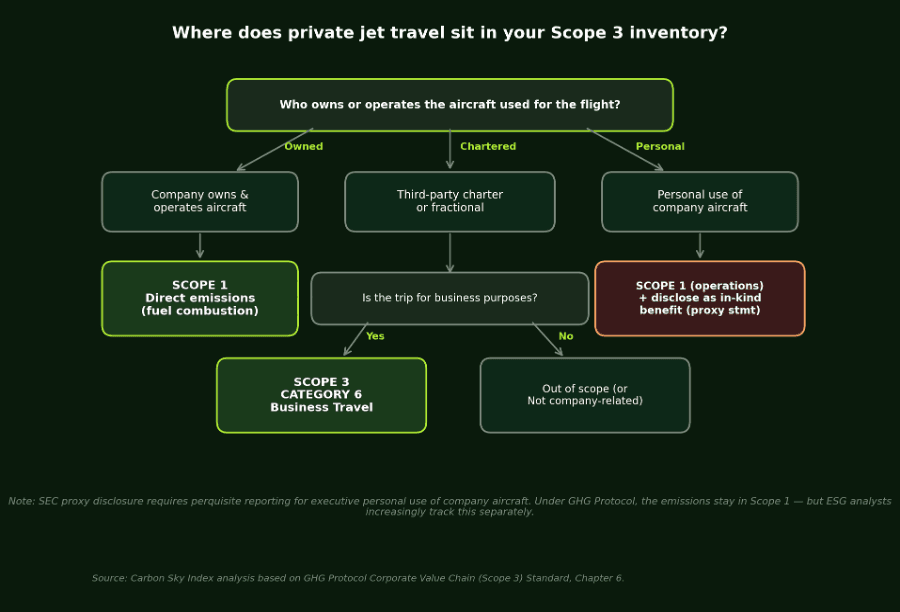
Owned and operated aircraft - Scope 1
If the reporting entity owns the aircraft and operates it directly (or through a wholly-owned management subsidiary), the fuel combustion emissions sit in Scope 1.
This is the simplest case from a categorisation standpoint, and the hardest in practice because it puts the entire emissions burden on the reporting company’s direct footprint, where reduction targets and assurance are most stringent.
Chartered, fractional, and jet card travel - Scope 3 Category 6
When a company books a flight on an aircraft owned and operated by a third party, such as a full charter, fractional ownership programmes such as NetJets, or jet card products, the emissions belong in Scope 3 Category 6 (Business Travel).
The GHG Protocol’s Technical Guidance for Calculating Scope 3 Emissions is explicit that air travel in vehicles not owned or operated by the reporting company falls under Category 6, alongside commercial flights, rail, hotel stays, and ground transport.
Personal use of company aircraft - the disclosure gap
This is where reporting gets uncomfortable.
When an executive uses a company-owned aircraft for personal travel, such as a weekend home, a family holiday, a non-business event, the emissions still sit in Scope 1 under the GHG Protocol, because the aircraft is owned and operated by the reporting entity.
There is no separate Scope 3 category for “personal use of company assets.”
In the United States, however, the Securities and Exchange Commission already requires companies to disclose the incremental cost of executive personal aircraft use as a perquisite in the annual proxy statement.
ESG analysts and short-sellers increasingly cross-reference these disclosures against ADS-B flight tracking data to estimate the emissions associated with personal travel.
A company that reports a clean Scope 1 number without separately quantifying executive personal use is, in practice, leaving a credibility gap that motivated investors will close themselves.
Even where not formally required by the GHG Protocol, voluntary supplemental disclosure of executive personal-use emissions is increasingly seen as a hallmark of mature corporate climate reporting. It is also one of the few disclosures that materially affects perceived governance quality.
What ESG standards apply to corporate private aviation?
Four overlapping frameworks now drive what companies are required or strongly expected to disclose.
The boundaries are not identical, and the trajectory of each matters.
GHG Protocol Corporate Standard and Scope 3 Standard
The GHG Protocol remains the foundational methodology.
It does not prescribe disclosure rather it prescribes how to calculate.
Almost every other framework defers to it for emissions inventory boundaries, scope categorisation, and calculation methods.
For private aviation specifically, the Scope 3 Standard’s Chapter 6 lays out three calculation approaches in declining order of accuracy: fuel-based, distance-based, and spend-based.
CSRD and ESRS E1 (European Union)
Following adoption of the Omnibus I Directive in February 2026, the CSRD now applies to companies with more than 1,000 employees and €450 million in turnover.
ESRS E1 (climate change) requires gross Scope 1, 2, and 3 emissions reported separately, with no netting of carbon credits.
Scope 3 disclosure is mandatory where material and the European Commission expects nearly all in-scope companies to find climate material under double materiality.
The amended ESRS E1 expected to take effect for FY 2027 reporting maintains the requirement to consider GHG Protocol Scope 3 boundaries when preparing inventories.
ISSB IFRS S2 (international, voluntary by jurisdiction)
The International Sustainability Standards Board’s IFRS S2 climate disclosure standard, adopted by the UK, Australia, Canada, and others, requires Scope 1, 2, and 3 emissions reported using the GHG Protocol.
ISSB takes an investor-information lens where disclosures must be decision-useful for capital allocators, which puts a premium on consistency, comparability, and methodology transparency.
California SB 253 (United States, state level)
With the SEC climate disclosure rule largely paused on Scope 3, California SB 253 has become the most consequential US Scope 3 mandate.
It applies to public and private companies with more than $1 billion in revenue doing business in California, requires Scope 1, 2, and 3 disclosure following the GHG Protocol, and phases in third-party assurance from 2026 (limited) to 2030 (reasonable).
Initial Scope 3 disclosures are due in 2027.
SBTi, CDP, TCFD
Science-Based Targets initiative validation, CDP questionnaires, and legacy TCFD-aligned disclosures all reference GHG Protocol boundaries.
SBTi requires Scope 3 inclusion where it represents more than 40% of total emissions.
A threshold that travel-heavy companies (consulting, finance, professional services) routinely exceed.
How to calculate the environmental impact of an aircraft fleet for investor reports
The GHG Protocol identifies three calculation methods for business travel, each with sharply different accuracy profiles.
For private aviation, the choice of method materially changes the disclosed number.
Method 1: Fuel-based (most accurate)
Direct measurement of fuel uplift, multiplied by an emission factor for jet fuel (typically 3.16 kgCO₂ per kg of Jet A-1, with adjustments for non-CO₂ effects).
This is the gold standard, but requires access to fuel records which is straightforward for owned aircraft, harder for charter.
Method 2: Distance-based (most common)
Great-circle distance between origin and destination, multiplied by an aircraft-specific or category-specific emission factor (gCO₂e per nautical mile or per passenger-km).
The EUROCONTROL EMEP/EEA methodology, which Carbon Sky Index uses, applies engine-specific LTO (Landing and Take-Off) cycle data plus cruise-phase fuel burn modelled on aircraft type.
This is the most defensible method when fuel data is unavailable.
Method 3: Spend-based (least accurate, often misleading)
Multiplying total spend on charter flights by an emission factor expressed in kgCO₂e per dollar.
This method is acceptable to the GHG Protocol as a fallback, but for private aviation it is systematically misleading.
A €30,000 short-haul charter on a Light jet and a €30,000 long-haul leg on a large jet have the same spend value but radically different carbon footprints.
Companies relying on spend-based methods routinely understate private aviation emissions by a factor of 2–4×.
For ESRS E1 and ISSB-aligned disclosure, distance- or fuel-based methods are strongly preferred. Spend-based reporting on private aviation is increasingly flagged in third-party assurance reviews.
Carbon Sky Index methodology in summary
Carbon Sky Index ingests ADS-B flight tracking data for over 22,000 private aircraft, applies the EUROCONTROL EMEP/EEA methodology with engine-specific LTO fuel flow data and cruise-phase modelling, and produces flight-level emissions estimates.
The full approach is documented in our methodology and broken down step-by-step in How private jet CO₂ emissions are calculated.
What metrics are important for tracking private jet emissions?
Total tCO₂e is the headline number, but it is the wrong metric to lead with. A meaningful disclosure framework includes intensity and concentration metrics that allow year-on-year comparison and benchmarking against peers.
1. Per-flight-hour emissions intensity
The most useful unit for cross-comparison. Emissions per hour normalises for trip length and reveals the underlying fleet profile.
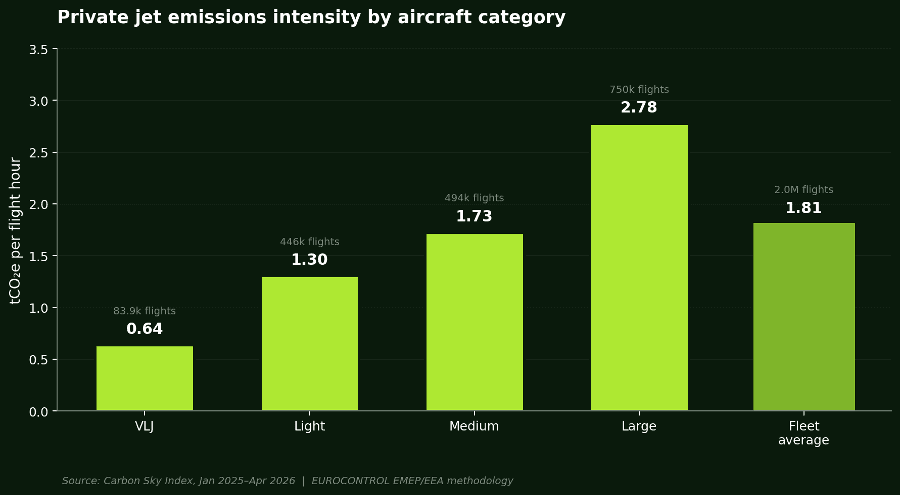
A fleet skewed toward large-cabin aircraft (Gulfstream G650, Bombardier Global 7500) will produce roughly four times the per-hour emissions of a light jet fleet.
Reporting only total emissions hides this - a company can reduce flight count by 10% while increasing emissions by switching to larger aircraft.
2. Per-mission emissions by haul
Short-haul flights (under 500 nautical miles) average 1.24 tCO₂e per flight in our dataset.
Mid-haul (500–1,500nm) averages 4.33 tCO₂e.
Long-haul (>1,500nm) averages 15.18 tCO₂e.
Disclosure of mission profile alongside total emissions tells investors whether the footprint is driven by frequency of short hops or by long-haul travel.
3. Aircraft-level concentration
In our dataset, the top decile of aircraft (by annualised emissions) accounts for a disproportionate share of the total.
The threshold for entry into the top 10% is approximately 730 tCO₂e per year.
The top decile averages 1,226 tCO₂e per year - 4.5 times the fleet average - and the highest-emitting single aircraft tracked emits over 4,000 tCO₂e per year.
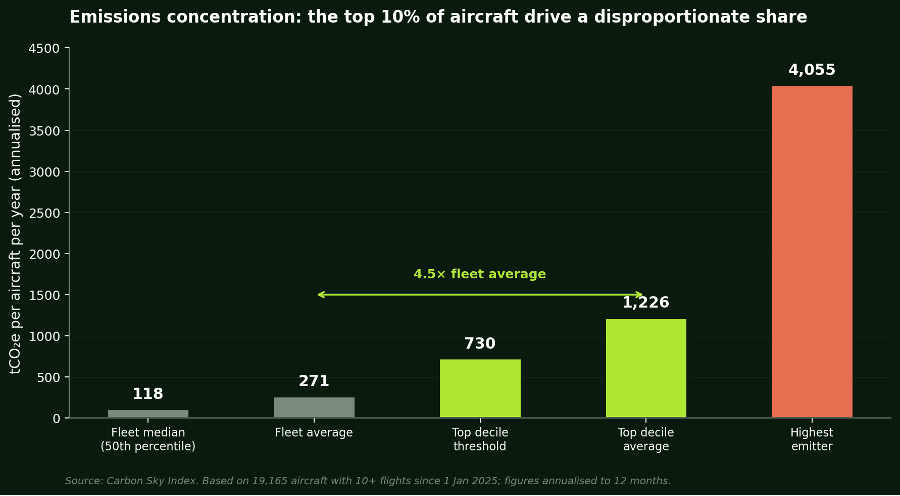
For a company with multiple aircraft, this distribution matters.
The fleet-average disclosure can mask a single high-utilisation airframe driving most of the footprint.
Investor-grade disclosure should identify whether emissions are evenly distributed across the fleet or concentrated in a small number of high-utilisation airframes.
4. Year-on-year change with consistent methodology
Apparent emissions changes between reporting years are frequently driven by methodology shifts (spend-based to distance-based) rather than real operational change.
Disclosing the methodology version alongside the number and restating prior years on a like-for-like basis when methodology changes, is now an expectation under ESRS E1’s consistency requirements.
5. SAF substitution claims
Sustainable Aviation Fuel (SAF) is the most-cited reduction lever in private aviation sustainability reporting.
The current visibility on actual SAF uplift across the global private fleet is however extremely limited.
There is no public registry, no mandatory reporting, and book-and-claim systems mean a company can buy SAF certificates without any physical fuel ever entering the aircraft they flew on.
For disclosure purposes, SAF claims should always cite the certification scheme, the volume in litres, and the lifecycle emission factor used. Vague “SAF-powered” claims do not survive limited assurance review.
Integrated platforms for private flight carbon and SAF reporting
Most corporate sustainability software (Watershed, Persefoni, Plan A, Sweep, Normative) ingests business travel data through travel agency feeds (TMC integrations with Amex GBT, BCD, FCM, etc.) and applies distance- or spend-based emission factors.
This works well for commercial flights, where the TMC has structured itinerary data and standard emission factors are well-established.
It works less well for private aviation.
Charter and fractional bookings often sit outside the TMC, in operator portals or finance systems.
Owned-aircraft operations are tracked in flight operations software (FOS, Leon, ARGUS) which rarely integrates with carbon accounting platforms.
The result: many companies are reporting their private aviation emissions through spreadsheet workarounds, with calculation methods that would not survive scrutiny.
Three integration patterns are emerging:
- Direct ADS-B-based emissions data feeds. Using flight tracking data to produce flight-level emissions estimates that can be ingested into carbon accounting platforms by tail number. This bypasses the TMC entirely and works equally well for owned, fractional, and charter flights.
- FBO and fuel uplift integration. Pulling actual fuel records from FBO networks (Signature, Million Air, Jet Aviation) for the most accurate fuel-based calculation. Coverage is uneven and bilateral data agreements are typically required.
- Operator-level reporting. Fractional and charter operators (NetJets, VistaJet, Flexjet, Wheels Up) increasingly publish per-flight or per-hour emissions reports for their customers. Quality and methodology vary; assurance is rare.
For a side-by-side comparison of platforms specifically focused on private jet emissions visibility, see The best platforms for tracking private jet carbon emissions.
How do companies report private jet emissions for ESG disclosure?
A defensible disclosure approach for private aviation has five elements that hold up under both auditor review and investor scrutiny.
First, scope categorisation.State explicitly which scope each portion of private aviation activity falls into, with rationale: Scope 1 for owned-and-operated, Scope 3 Category 6 for chartered business travel, supplemental disclosure for executive personal use of company aircraft.
Second, activity data quality. Disclose the source of activity data (tail-number flight logs, TMC bookings, fuel uplift records, ADS-B tracking), the percentage of flights covered, and any gaps or estimates used to fill them.
Third, calculation methodology. Cite the GHG Protocol method used (fuel-based, distance-based, spend-based), the emission factor source (DEFRA, EUROCONTROL EMEP/EEA, ICAO, supplier-specific), and any non-CO₂ effect adjustments (radiative forcing multipliers, contrail accounting).
Fourth, metric selection. Lead with total tCO₂e but include intensity and concentration metrics: per-flight-hour, per-mission, per-employee where relevant.
Fifth, reduction levers and SAF transparency. Where SAF is claimed, disclose volume, certification scheme, lifecycle emission factor, and whether the SAF was physically uplifted on company flights or acquired through book-and-claim.
The direction of travel
Private aviation is the most carbon-intensive form of corporate travel and, until recently, the least scrutinised.
That asymmetry is closing rapidly.
ESRS E1 limited assurance is now in force for Wave 1 CSRD reporters. ISSB-aligned mandates are rolling out across the UK, Australia, Canada, Japan, and Brazil.
California SB 253 first disclosures are due in 2027.
Each of these regimes will, over the next three years, produce auditor questions about activity data quality, methodology selection, and the treatment of executive personal use.
The companies that get ahead of this by adopting fuel or distance-based methods, separately disclosing personal-use emissions, and tracking concentration as well as totals will avoid the restatement risk and credibility damage that companies still relying on spend-based estimates increasingly face.